> For the complete documentation index, see [llms.txt](https://docs.theiamarkerless.com/llms.txt). Markdown versions of documentation pages are available by appending `.md` to page URLs; this page is available as [Markdown](https://docs.theiamarkerless.com/apollo-v2024/theia3d-documentation/getting-started/installation.md).
# Installation
{% hint style="warning" %}
Note that administrator privileges are required for installation and licensing.
{% endhint %}
## **Installation Steps**
{% stepper %}
{% step %}
### Login
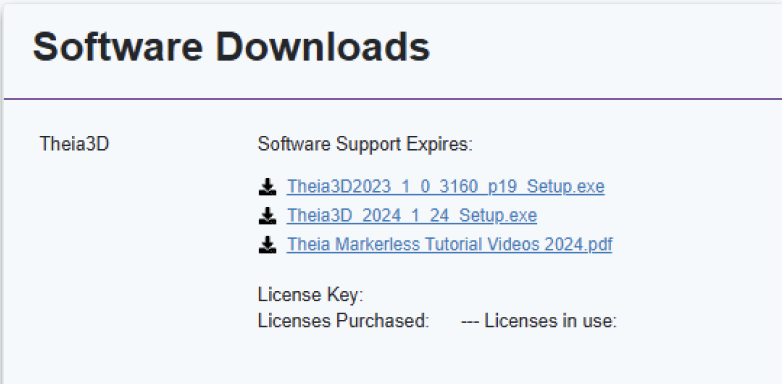
Login to the Theia Software Downloads [portal](https://service.theiaserver.com/login) using the login credentials provided to you in our welcome email.
* Download the Theia3D application installer.
* If available, download the Graphics Card Engines for your GPU.
{% hint style="info" %}
**Note:** If none are available for your GPU, they will be built automatically the first time Theia3D is run.
{% endhint %}
* Copy your license key for safekeeping offline.
{% endstep %}
{% step %}
### Drivers
Check that your [NVIDIA graphics card drivers](https://www.nvidia.com/download/index.aspx) are up-to-date. If not, download and install the latest drivers from NVIDIA.
{% endstep %}
{% step %}
### Run Theia3D
Run the Theia3D application installer and follow the instructions
* You must scroll to the bottom of the EULA to accept it.
* If you downloaded a Graphics Card Engine from the Theia Software Downloads portal, run the executable once the Theia3D application installer has finished.
{% endstep %}
{% step %}
### Launch Theia3D for the first time.
* When prompted, enter your license key to activate the software.
* If a Graphics Card Engine was not available for your GPU from the Theia Software Downloads portal, they will be built automatically at this stage. This can take several (\~30) minutes, but is only required the first time Theia3D is opened.
{% endstep %}
{% endstepper %}
Theia3D installer downloads and license details.
Theia3D engines installers.
---
# Agent Instructions
This documentation is published with GitBook. GitBook is the documentation platform designed so that both humans and AI agents can read, navigate, and reason over technical content effectively. Learn more at gitbook.com.
## Querying This Documentation
If you need additional information that is not directly available in this page, you can query the documentation by asking a question.
Perform an HTTP GET request on the following URL with the `ask` and `goal` query parameters:
```
GET https://docs.theiamarkerless.com/apollo-v2024/theia3d-documentation/getting-started/installation.md?ask=&goal=
```
`ask` is the immediate question: it should be specific, self-contained, and written in natural language.
`goal` is what the user is ultimately trying to achieve, the reason they need the answer. Sharing it helps GitBook give you a better, more relevant answer. A goal is most helpful when it describes the outcome the user wants rather than restating the question. For example, with `ask=how do I create an API token`, a goal like `automate deployments from our CI pipeline` lets GitBook tailor the answer to that use case.
The response will contain a direct answer to the question and relevant excerpts and sources from the documentation.
Use this mechanism when the answer is not explicitly present in the current page, you need clarification or additional context, or you want to retrieve related documentation sections.